Best Time to Stream on Twitch and Kick for New Streamers - 4 Ways to Find Yours
For small and mid-size streamers, timing decides discovery. On both Twitch and Kick, many viewers usually click the top streams in each category.
Peak hours tempt most streamers, but they are a trap… more viewers show up, but so do bigger channels. The real sweet spot is active viewers plus less competition in your category.
Quick Answer - What Are The Best Times to Stream on Twitch / Kick?
The best time to stream on Twitch is between 12 AM and 8 AM. Pacific Time, since fewer streamers are online, and you can also catch European audiences waking up and scrolling.
The best time to stream on Kick is 6 PM to 11 PM Pacific Time, but this is not a magical hour. The best hours are when you can hit consistently without burning out, because Kick has less competition and timing is slightly less strict early on.
Finding Your Best Time to Stream on Twitch and Kick
The best time to stream on Twitch/Kick is not a universal chart that works for everyone. It depends on the game or category, your time zones, your target audience, and how many other channels go live at the same time.
Use Analytics: Viewer to Channel Ratio
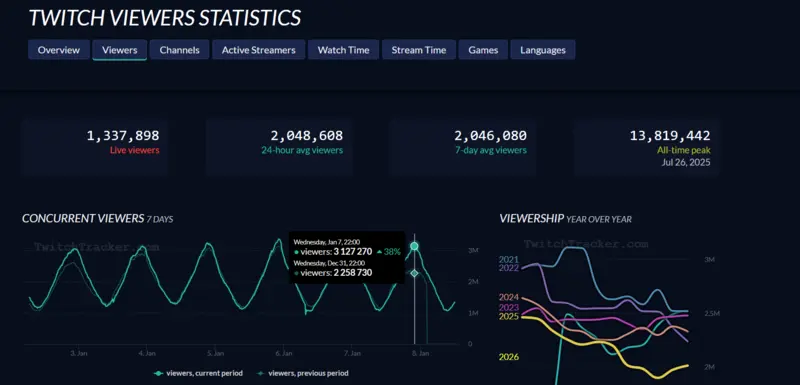
Use Twitch Tracker to find which game has the highest viewership per channel ratio, because that often signals an opportunity: enough viewers, but fewer streamers competing for them.
After you pull the data, you can rank days in descending order to find the easiest days to get discovered for that specific streaming category.
Experiment a 14 to 30 Day Testing Cycle (One Variable at a Time)
Keep the same game, the same duration, and the same format every time, then change only the start time. Track average viewers, chat messages per minute, and new followers per hour. Your goal is the time block with the best follower-to-viewer ratio.
Use Your Own Twitch Analytics
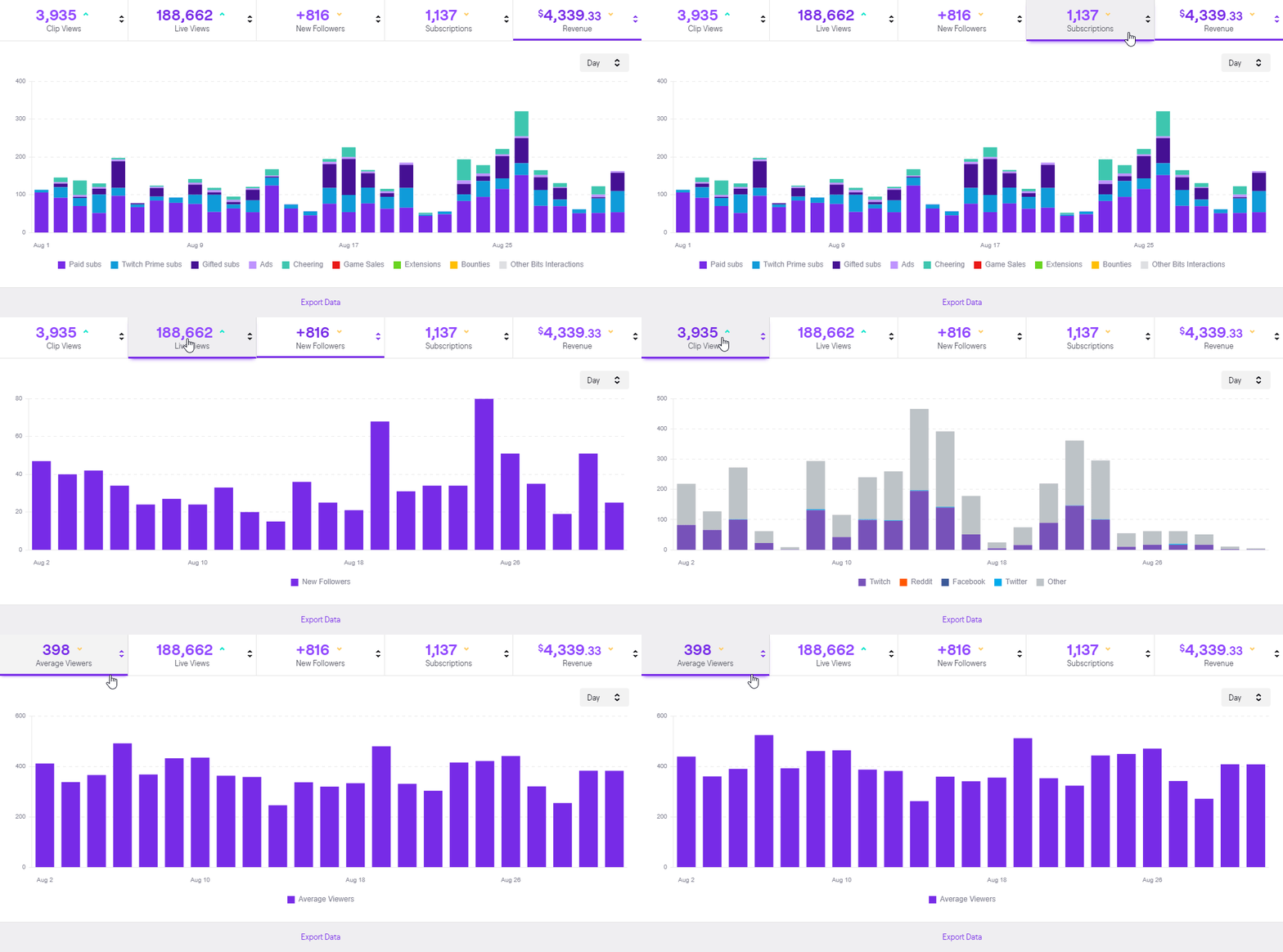
Past broadcasts can reveal the days and hours that had the strongest viewer engagement.
When you spot patterns, you can build a Twitch streaming schedule around them. Analytics also helps you notice when your audience is shifting, since the “best time” often changes as your channel grows and attracts different viewer demographics.
Adjust Strategy by Platform (Twitch vs Kick)
On Twitch, timing is more sensitive because saturation is real and discoverability is mostly live-only. Off-peak hours plus early viewer momentum can lift your placement in category lists, which can change everything for a small streamer.
On Kick, there is less competition, so timing is not as strict early on, and a consistent schedule can matter more than a perfect time slot. Prime time can still work for smaller creators.
The core move is still the same, though: test, track, refine, then lock it in, but if you want a deeper explanation, you can check our guide on Twitch vs Kick.
Worst Times to Stream on Twitch and Kick
The worst time to stream is any time when your category is dominated by large creators and your channel sits far down the list. In that situation, even strong content can struggle because potential viewers never see it.
Another “worst time” is a schedule that constantly changes. When people cannot predict when you go live, they stop checking, and viewer feedback drops over time. Twitch punishes this more than Kick, because Twitch relies so much on live visibility and routine audience return.
Best Time to Stream by Content Type
Content type changes the whole timing game. A “good” hour in a crowded category can still be a dead hour for a small channel, because nobody ever scrolls far enough to find it.
But in a quieter category, the same viewer count can push a stream higher, spark more chat, and turn random clickers into followers.
So the best time to stream depends on viewer intent and competition.
These below are not the best, but the most logical streaming times for some popular categories:
| Content Type | Time Blocks (PST) | Why? |
|---|---|---|
| Gaming (Competitive) | 12:00 AM to 4:00 AM, plus 6:00 AM to 11:00 AM (midweek) | Fewer live channels means better ranking odds. |
| Gaming (Casual) | 10:00 AM to 1:00 PM (weekdays), 11:00 AM to 2:00 PM (weekends) | Daytime browsing is strong for chill games. |
| Just Chatting / IRL | 7:00 PM to 11:00 PM, then test 10:00 PM to 1:00 AM | Viewers show up after work. |
| Music and Creative | 10:00 PM to 1:00 AM, plus 12:00 AM to 8:00 AM | Many viewers treat it like background entertainment. |
| Crypto or Niche | 8:00 AM to 12:00 PM, plus 10:00 PM to 12:00 AM | Lower competition, small spikes rank you fast. |
Weekdays vs Weekends - What Actually Performs Better?
Weekends usually bring more raw viewers. People stay up later, and time zones overlap more. That creates bigger crowds, especially at night. The problem is that it also creates bigger competition.
Weekdays can be quieter, and that is the advantage. In many categories, fewer channels are live in certain blocks. That makes it easier for a smaller stream to rank higher, get clicked, and hold new viewers.
Why “Best Time” Changes as You Grow
At the start, “best time” is really just the time you can get noticed. A small channel needs breathing room, so lower-competition hours usually work better.
You show up higher in the list, more people actually see you, and a few clicks can turn into real followers.
Later, the rules change when you have regulars. Peak hours are not scary anymore, because those regulars bring the first wave that keeps the stream from looking empty.
Early on, the win is new followers per hour. Later, the win is people staying longer and coming back.
If you want that “first wave” on purpose, ViewBotter tools can help set it up. Use the ViewerBot, ChatBot, and FollowBot for both Twitch and Kick to add stable viewers, active chat, and stronger social proof from minute one.
FAQ
Is it better to stream in the morning or late at night?
Late night usually wins for small channels. Less competition means higher placement and more random clicks.
Do weekends perform better than weekdays?
Weekends bring more viewers, but also more big channels. Weekdays can grow faster in quieter hours.
Does Kick have less competition than Twitch?
Yes. Kick usually has fewer live channels per category, so smaller channels can get noticed sooner.
Should small streamers avoid prime time?
Most should. Prime time is crowded. Off-peak hours give better visibility with the same viewer count.
How long before timing data becomes reliable?
Aim for 14 days minimum. 30 days is better. Keep everything the same and change only the start time.
What are peak hours for streaming?
Peak hours are when most viewers are online. They bring traffic, but competition spikes hard too.
What are the golden hours for Twitch?
Golden hours are low competition, plus active viewers. Late night and early mornings often perform best.