Twitch Ad Revenue in 2026: 7 Things That Determine What You Earn
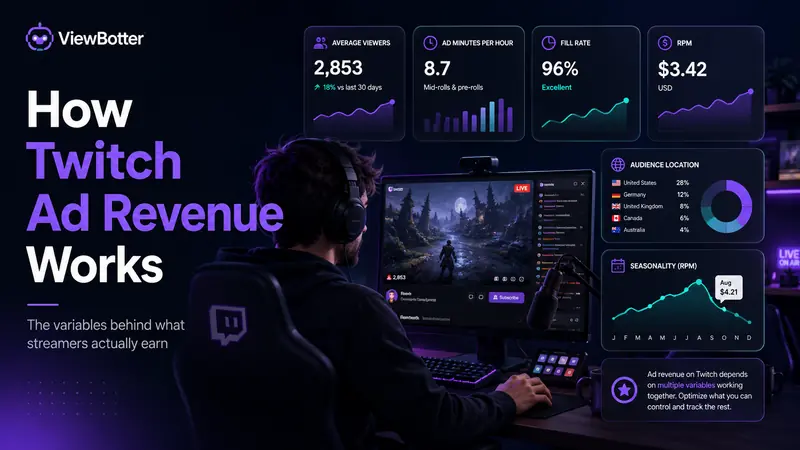
Quick Answer: How Does Twitch Ad Revenue Work?
Twitch makes money by showing advertisements to viewers and shares part of the resulting ad revenue with eligible Twitch streamers.
In 2026, Twitch Affiliates and Partners can unlock a 55% Net Ad Revenue Share by running at least three minutes of ads per hour through Ads Manager. Twitch confirms that this requires three minutes of mid-roll ads per hour; pre-rolls do not count toward the requirement.
But 55% revenue share does not mean Twitch pays one fixed CPM.
Actual Twitch ad revenue depends on things like:
- Average concurrent viewers
- Ads and ad minutes per hour
- Ad fill rate
- Audience location
- Advertiser demand
- Seasonality
- Adblock and other non-monetized views
So calculations like average viewers × one random Twitch CPM are useful for napkin math, but they don’t tell the full story.
Who Can Earn Money From Twitch Ads in 2026?
Twitch made a pretty big monetization change in 2026.

Beginning in May, Twitch expanded access to tools including subscriptions, Bits, emotes, badges and Channel Points to eligible streamers globally. However, simply getting access to those tools does not mean a streamer can receive a cash payout.
Twitch still requires Affiliate or Partner status for payouts, and ads remain an Affiliate and Partner monetization feature.
Twitch also lowered its Affiliate requirements in 2026. The current requirements are:
- 25 followers
- 4 total hours streamed
- 4 different streaming days
- At least 3 average concurrent viewers on 4 different days
Those four achievements need to be completed within Twitch’s qualifying framework before the streamer receives an Affiliate invitation.
Still grinding toward Affiliate?
Check your Twitch Affiliate progress instead of trying to do the requirements in your head.
What Does Twitch’s 55% Ad Revenue Share Actually Mean?
This is where Twitch ad revenue gets misunderstood.
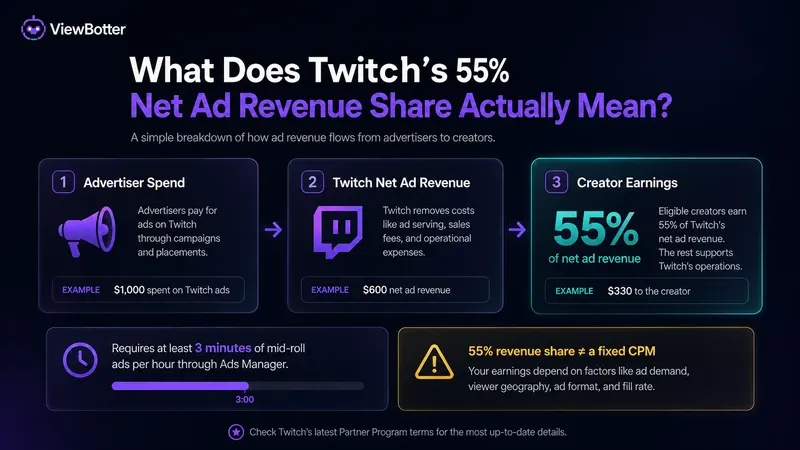
There are three different numbers involved:
Advertiser spend is what an advertiser pays to run ads.
Net ad revenue is the revenue figure Twitch uses when applying its creator revenue share.
Creator earnings are the streamer’s resulting share.
When Twitch says eligible Affiliates and Partners can receive a 55% Net Ad Revenue Share, it is talking about the second number—not promising a streamer 55 cents from every dollar originally paid by an advertiser for every individual impression.
In other words:
55% revenue share ≠ a fixed 55% CPM
Revenue share and CPM are two different parts of the advertising model.
That distinction matters because someone searching “how much does Twitch pay per 1,000 views?” usually wants one clean number.
Unfortunately, there isn’t one.
Twitch ad earnings still depend on how much monetized advertising was actually delivered and what that inventory was worth.
How Twitch Ads Manager Works
Ads Manager is Twitch’s built-in system for scheduling ads during a stream.
A Twitch streamer can configure:
- Ad minutes per hour
- Ad length
- Ad frequency
- Scheduled mid-rolls
- Automatic scheduling
- Pre-roll behavior
Twitch currently says running at least three minutes of mid-roll ads per hour through Ads Manager unlocks the 55% net ad revenue share for Affiliates and Partners. Running those three minutes can also disable pre-roll video ads for incoming viewers.
Ads Manager can automatically determine ad length and frequency, or streamers can choose their own setup.
Timing matters, though.
Smashing the ad button in the middle of the final boss fight because the spreadsheet says “more ads = more money” is a pretty efficient way to annoy everyone.
Better moments include:
- Bathroom breaks
- Matchmaking
- Queue times
- Food or drink breaks
- Game changes
- Natural transitions between segments
Ad revenue matters. Viewer retention matters too.
The best ad setup is therefore not automatically the one that produces the largest possible number of ad minutes.
Pre-Roll vs Mid-Roll Twitch Ads
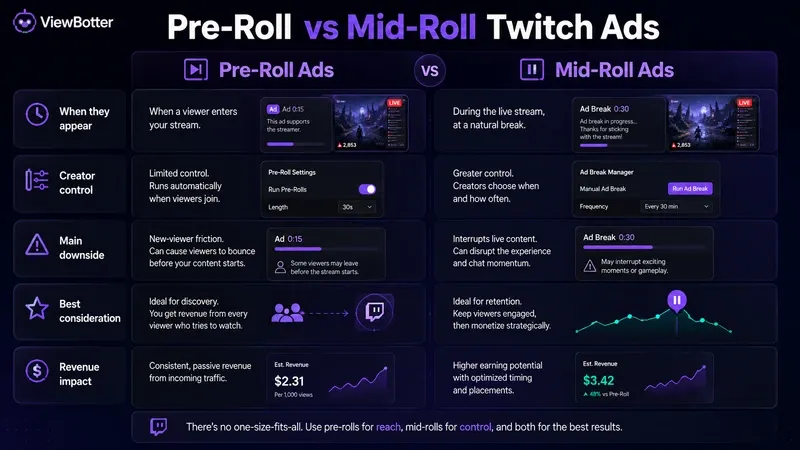
Twitch ads generally create two different headaches: annoying somebody before they have even seen the stream, or interrupting somebody who is already watching.
| Pre-Roll Ads | Mid-Roll Ads | |
|---|---|---|
| When they appear | When a viewer enters | During the stream |
| Creator control | Limited | Greater scheduling control |
| Main downside | Interrupts the first impression | Interrupts live content |
| Best consideration | New-viewer friction | Timing and retention |
| Revenue impact | Can create ad impressions | Creates more controllable ad volume |
There isn’t one perfect configuration for every Twitch channel.
A smaller Twitch streamer fighting for discovery may care heavily about reducing friction when new viewers arrive.
A large established streamer with thousands of concurrent viewers may be able to run a different ad schedule without affecting the channel in the same way.
The useful question isn’t simply:
“Which Twitch ads pay more?”
It’s:
“Which setup produces monetized impressions without making viewers leave?”
What Actually Determines Twitch Ad Revenue?
Viewer count matters. It just isn’t the entire revenue model.
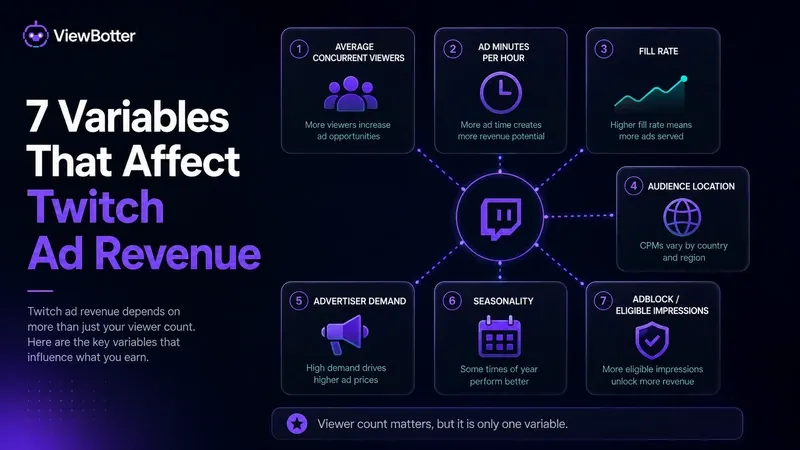
These are the seven variables that matter most.
1. Average Concurrent Viewers
More real viewers create more opportunities for monetized ad impressions.
A Twitch stream averaging 1,000 concurrent viewers obviously has much more potential advertising inventory than one averaging 10.
But CCV by itself can’t predict ad revenue.
Two Twitch streamers averaging 500 viewers can still earn differently because those viewers may live in different countries, see different numbers of ads or generate different amounts of monetized inventory.
2. Ad Minutes Per Hour
More advertising creates more potential ad impressions.
That does not mean endlessly increasing the number of ads is automatically profitable.
A streamer could theoretically create more advertising opportunities while simultaneously hurting retention because viewers are getting hammered with interruptions.
Revenue per hour and viewer behavior need to be considered together.
3. Fill Rate
An available advertising opportunity doesn’t guarantee that an eligible advertiser will serve an ad to every viewer.
That’s essentially what fill rate helps represent.
Imagine a Twitch channel creates 10,000 potential ad impressions.
If only 7,000 are actually filled with eligible paid advertising, revenue is being generated from those monetized impressions—not the theoretical 10,000.
This is one of the biggest things a simplistic Twitch revenue calculator can overlook.
4. Audience Geography
Not every viewer represents the same advertising market.
Advertiser demand, competition and rates differ between countries and regions.
That means a streamer whose Twitch audience is heavily concentrated in one high-demand advertising market can generate different revenue from another streamer with identical CCV but a completely different audience mix.
So “100 viewers” isn’t really a complete piece of information.
Where those viewers are matters too.
5. Advertiser Demand
Twitch doesn’t exist in an advertising vacuum.
Twitch inventory is available within Amazon’s broader advertising ecosystem, including Amazon DSP, where advertisers can access Twitch inventory alongside other Amazon-owned properties.
The important part for streamers is simple:
Advertiser demand changes.
More competition for advertising inventory can affect what impressions are worth. Weaker demand can push results in the other direction.
6. Seasonality
Advertising budgets are not evenly distributed through the year.
One month can behave very differently from another.
That’s why comparing December Twitch ad revenue directly with January and assuming something is broken can be misleading.
For a useful comparison, streamers should look at equivalent periods:
- Q1 vs previous Q1
- Q4 vs previous Q4
- Same month year over year
Seasonality is also one reason a single permanent “Twitch CPM” number doesn’t make much sense.
7. Adblock and Eligible Impressions
Not every person represented in the viewer count necessarily produces a paid advertising impression.
Adblock usage and other eligibility factors can reduce monetized ad delivery.
Twitch Turbo subscribers, for example, do not see ads scheduled through Ads Manager.
That creates another gap between:
theoretical viewers
and
revenue-producing impressions.
And that gap is exactly why Twitch streamers should be careful when estimating revenue from CCV alone.
Why Simple Twitch Ad Revenue Estimates Can Miss the Mark
Twitch ad calculators are useful for getting a ballpark figure.
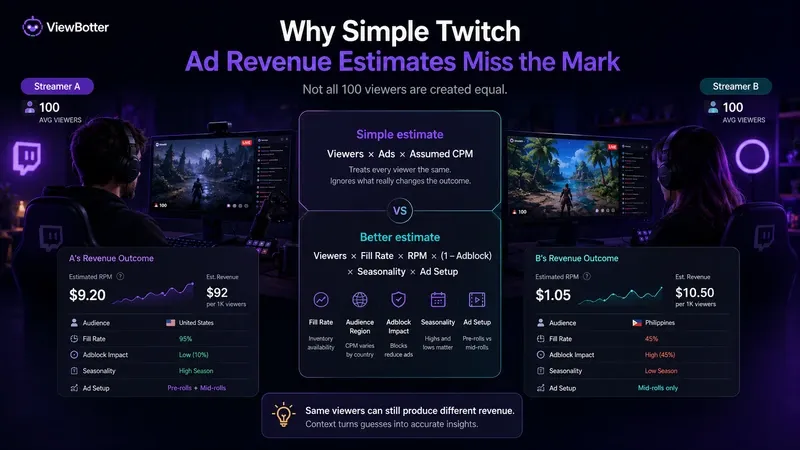
The problem is that the result can only be as useful as the variables the calculator models.
A basic calculation might effectively work like this:
Viewers × ads × assumed CPM = estimated revenue
That’s fine when somebody wants a five-second comparison.
It becomes much shakier when that same number gets treated like an expected Twitch payout.
A more detailed Twitch ad revenue estimate can account for:
- Average concurrent viewers
- Actual streaming hours
- Days streamed
- Ads per hour
- Pre-roll vs mid-roll configuration
- Fill rate
- Adblock impact
- Audience region
- RPM
- Seasonality
- Viewer retention and ad timing
That’s the approach behind ViewBotter’s Twitch Ad Revenue Calculator.
Instead of locking every streamer into one universal CPM assumption, it lets streamers adjust RPM, fill rate, adblock impact, audience location, streaming frequency, seasonality, ad density and pre-roll settings.
It also separates estimated pre-roll and mid-roll revenue.
That doesn’t magically make any calculator capable of predicting Twitch’s exact future payout.
It does make the model more useful for planning because more of the variables that change real-world ad delivery are actually represented.
Calculate your Twitch ad revenue using the stream’s actual setup instead of relying on viewer count alone.
Twitch Ad Revenue Example: 100 Viewers Doesn’t Always Equal the Same Money
Take a streamer averaging 100 concurrent viewers.
Assume the channel:
- Streams 50 hours
- Averages 100 viewers
- Runs 3 ad minutes per hour
That creates:
100 viewers × 50 hours = 5,000 viewer-hours
and potentially:
5,000 viewer-hours × 3 ad minutes = 15,000 viewer-ad-minutes
A basic Twitch earnings estimate could take that activity, convert it into assumed advertising impressions and apply one fixed CPM or RPM.
Useful as a rough benchmark.
But now imagine the exact same Twitch channel with the exact same 100 average viewers and streaming schedule.
This time the estimate also considers:
- Actual fill rate
- Adblock impact
- Audience region
- Selected RPM
- Pre-roll configuration
- Quarter and seasonality
Suddenly the answer can change without the streamer gaining or losing a single average viewer.
That’s the point.
There is no responsible way to say:
“A Twitch streamer with 100 viewers makes exactly $X from ads.”
The better statement is:
“Under these assumptions, a Twitch streamer averaging 100 viewers could generate approximately $X.”
Then change the assumptions and see what happens.
Calculate your own stream instead →
How Much Do Twitch Streamers Make From Ads?
There isn’t one reliable dollar range that applies to every Twitch streamer.
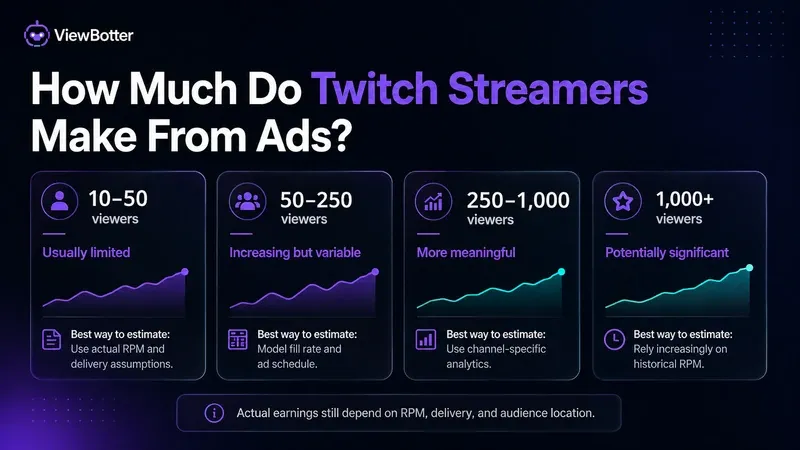
Ad earning potential tends to become more meaningful as average viewership increases because more viewers create more opportunities for monetized impressions.
| Average Viewers | Ad Earning Potential | Best Way to Estimate |
|---|---|---|
| 10–50 | Usually limited | Use actual RPM + delivery assumptions |
| 50–250 | Increasing but variable | Model fill rate and ad schedule |
| 250–1,000 | More meaningful | Use channel-specific analytics |
| 1,000+ | Potentially significant | Historical channel RPM becomes increasingly useful |
For a small streamer, Twitch ads will usually be supplementary income.
For a growing streamer, ad revenue can become noticeable, but location, ad frequency and delivery still matter.
For a large Twitch channel with thousands of viewers, the sheer amount of monetizable inventory means ads can become a meaningful revenue stream.
The important bit?
Two Twitch streamers with the same average viewer count can still report completely different ad earnings.
Can You Actually Make Money From Twitch Ads?
Yes.
But making money from Twitch ads and making enough money from Twitch ads to support yourself are two very different achievements.
For newer streamers, advertising usually makes more sense as one part of a larger revenue stack:
- Ads
- Twitch subscriptions
- Twitch Bits
- Direct donations
- Sponsorships
- Affiliate links
- YouTube or other content
- Merch and external products
A small Twitch channel may technically earn revenue from ads while still receiving very little compared with subscription revenue or direct viewer support.
As a stream grows, all of those revenue streams can scale together.
More real viewers don’t only create more ad opportunities. They can also mean more potential Twitch subs, Bits, sponsorship value and off-platform growth.
Calculate Your Twitch Ad Revenue
Estimating Twitch ads becomes much more useful once the question changes from:
“What CPM does Twitch pay?”
to:
“What variables actually affect this channel?”
ViewBotter’s Twitch Ad Revenue Calculator lets streamers enter and adjust factors including:
- Average concurrent viewers
- Streaming hours
- Days streamed
- Ad minutes per hour
- Pre-roll configuration
- RPM
- Fill rate
- Adblock impact
- Audience region
- Seasonality
The calculator can then generate daily, weekly, monthly and annual estimates while separating estimated pre-roll and mid-roll revenue.
Calculate Your Twitch Ad Revenue →
Twitch ad revenue isn’t exactly mysterious. It’s just considerably messier than multiplying viewer count by a CPM.
The 55% net revenue share explains how Twitch structures eligible creator participation, but actual earnings still depend on the number and value of paid impressions that get served.
For smaller Twitch streamers, ads are usually one piece of a larger monetization strategy rather than the entire paycheck.
And if a streamer wants an estimate based on the channel’s actual audience and ad setup rather than a generic Twitch CPM pulled from somewhere online, that’s exactly what the calculator is there for.
Twitch Ads vs Subscriptions: Which Makes More Money?
Neither one universally wins.
They work differently.
| Ads | Subscriptions | |
|---|---|---|
| Depends on CCV | Heavily | Indirectly |
| Recurring | Variable | Monthly |
| Viewer action required | Mostly passive | Yes |
| Revenue predictability | Lower | Generally higher |
| Main variable | Monetized impressions | Paying subscribers |
For many smaller Twitch streamers, one additional subscription is easier to understand financially than one additional viewer.
A subscription creates a relatively clear revenue event.
An extra viewer might:
- Receive multiple ads
- Receive fewer ads
- Be blocked from some ad delivery
- Come from a different advertising market
- Leave before an ad break
- Never produce a monetized impression
Want to model subscription revenue instead?
Try the Twitch Subscriber Earnings Calculator.
How to Make More From Twitch Ads Without Wrecking the Stream
Ad optimization shouldn’t mean treating viewers like walking impressions.
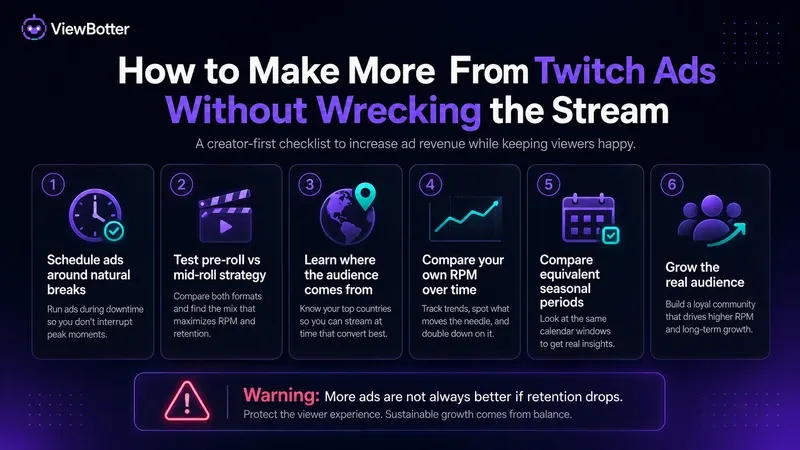
Schedule ads around natural breaks
Queue time? Bathroom break? Switching games?
Perfect.
Final round of a tournament?
Maybe don’t.
Test pre-roll vs mid-roll strategy
Running mid-roll ads can reduce pre-roll exposure for incoming viewers.
Streamers should watch retention data and decide which setup works best for their own channel.
Learn where the audience comes from
Audience geography can materially change ad monetization.
Understanding the channel’s actual viewer mix is more useful than assuming every Twitch viewer has identical advertising value.
Compare the channel’s own RPM
Historical Twitch analytics become more useful as a streamer collects more data.
Somebody else’s RPM isn’t automatically yours.
Compare equivalent periods
December and January can behave differently because advertiser demand changes.
Month-to-month panic is less useful than comparing similar seasonal periods.
Grow the real audience
This is still the big one.
More genuine viewers and better retention create more monetization opportunities across Twitch ads, subscriptions, Bits, sponsorships and everything else around the stream.
Artificial viewers should not be treated as a way to generate advertising impressions or ad revenue.
For legitimate audience-building strategies, check out how to grow your Twitch audience.
Mistakes to Avoid With Twitch Ads
A few Twitch ad revenue myths refuse to die.
- Assuming Twitch has one universal CPM. Actual rates and creator revenue vary.
- Multiplying CCV by a random CPM found on Google. Fine for rough math. Weak for serious revenue planning.
- Assuming every viewer receives every ad. Actual delivery can vary.
- Ignoring audience geography. One hundred viewers aren’t automatically economically identical.
- Ignoring seasonality. Advertising demand changes throughout the year.
- Confusing advertiser CPM with creator RPM. They describe different sides of the advertising system.
- Running ads at terrible moments. A few extra impressions aren’t worth nuking the viewer experience.
- Treating a Twitch revenue calculator as guaranteed income. A calculator models scenarios. It doesn’t have access to Twitch’s future payout ledger.
Where ViewBotter Fits In
Ad revenue only gets interesting once a stream has an audience, and that’s where ViewBotter fits in. ViewBotter is not an ad-revenue shortcut, our bots do not watch ads.
Instead, the Twitch Viewer Bot helps a channel escape the zero-viewer zone and improve visibility, the Twitch Chat Bot adds activity so quieter streams do not feel dead, and the Twitch Follow Bot strengthens social proof around the channel.
The goal is to give real growth more room to happen while the streamer keeps improving content, retention, and monetization. Not sure if it fits? Try ViewBotter free for 30 minutes with 25 viewers and 25 chatters, no credit card required.
Twitch Ad Revenue FAQ
How much does Twitch pay per 1,000 views?
There isn’t one universal Twitch payout for every 1,000 views. Ad revenue depends on monetized impressions, advertiser demand, audience location, ad frequency, fill rate and the creator’s effective RPM.
Does Twitch pay $3.50 per 1,000 viewers?
Older Twitch discussions often use fixed CPM-style figures, but one universal CPM is not a reliable way to describe the current system. Twitch describes eligible creator advertising earnings using its net ad revenue share.
What percentage of ad revenue does Twitch give streamers?
Twitch currently allows Affiliates and Partners to unlock a 55% Net Ad Revenue Share by running at least three minutes of ads per hour through Ads Manager.
How many ads do streamers need to run to get the 55% revenue share?
The requirement is based on ad time rather than simply a number of individual ads. Twitch currently requires at least three minutes of mid-roll ads per hour through Ads Manager to unlock the 55% net ad revenue share.
Can small Twitch streamers make money from ads?
Yes. However, Twitch ad revenue will generally be limited when the number of monetized impressions is small. Advertising can become a larger part of total revenue as average viewership grows.
Why did Twitch ad revenue drop even though viewers stayed the same?
Viewer count is only one variable. Advertiser demand, seasonality, audience geography, ad delivery, RPM, adblock usage and viewer behavior can all change earnings without CCV changing.
How accurate are Twitch ad revenue calculators?
They’re estimates. A calculator that models variables such as fill rate, RPM, adblock impact, audience region, ad load and seasonality can provide a more detailed projection than a fixed-CPM calculation, but it still can’t guarantee an actual Twitch payout.